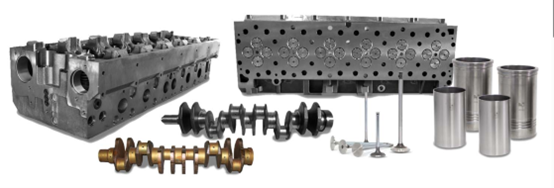
The diesel generator intake and exhaust valve is a precision part that seals the combustion chamber and controls the gas exchange of the diesel generator during the working process of the diesel generator, and is an important part to ensure the power, economy, reliability and durability of the diesel generator. The working conditions of the valve are harsh, the working temperature of the intake valve can reach 300~400°C, and the working temperature of the exhaust valve can reach 700~900°C. The working surface of the valve is easy to be ablated during work, and the exhaust valve of some brands of generator sets is expensive and in short supply, so it is of great significance to master the timing, causes and repair skills of the working face ablation, which is of great significance to extend the service life of the valve and save maintenance costs. 1. Repair method of exhaust valve working surface
As we all know, diesel generator exhaust valves are more expensive than intake valves, and some imported exhaust valves are not easy to buy. Therefore, mastering the repair skills of the exhaust valve working surface is of great significance to extend the service life of the valve and save maintenance costs. Practice has proved that the oxyacetylene neutral flame spray welding process is more suitable, such as the selection of Ni45 alloy powder produced by Jiangsu Taixing, which can make the repaired valve deformation small, and the spray welding layer has good corrosion resistance, wear resistance, heat resistance and oxidation resistance. This solder powder belongs to the Ni-Cr-Si series, which also contains 10% cobalt. The spray welding process is as follows:
- Preparation for spray welding
(1) Completely remove the oil stains and carbon deposits of the valve, check the valve, there should be no cracks, and the diameter of the head should meet the requirements of the original factory. The valve face is then turned into an arc groove (see Figure 1). The purpose of the groove is to remove the surface fatigue layer and the pit layer, form a certain surface roughness, and create a suitable cavity to accommodate the spray welding alloy.
(2) Use SPH-1/h spray welding torch, oxygen pressure 40KPa, acetylene pressure ≥50KPa, valve speed 1-1.5r/min.
- Spray welding operation
(1) One-step spray welding. First, the entire valve head is preheated to about 250 °C with a flame, and then the flame is heated and heated at the welding point of the valve working face, and the powder feed switch of the spray gun is pressed to feed the powder intermittently or continuously. When the flame is 10-20mm away from the working surface, the border powder is remelted, and when there is a “mirror reaction” at the remelting site, the spray gun moves forward until the entire working surface is covered by the welding layer.
(2) After spray welding, the valve should be placed vertically on the iron plate, and after cooling to room temperature in the air, the working surface of the valve can be polished.
- Common forms of damage to diesel generator valves
- Diesel generator valve wear
The valve clearance is too large, and the valve and valve seat collide and knock with each other during the engine operation, causing the working face to groove and widen. The exhaust valve is impacted by high-temperature gas, which will oxidize and melt the working surface, resulting in spots and dents. The valve stem constantly rubs in the valve guide, increasing the mating gap, and shaking in the tube, causing the partial wear of the valve head, and the air leakage due to poor closing. After long-term work, the valve will also wear out the tapered working surface, rod and lower end face of the head.
- The valve of the diesel generator is burned alone
Air leakage caused by poor sealing of valves and valve seats is the direct cause of melting burns. When replacing the valve, the valve seat is poorly matched, the valve clearance is too small, the valve spring elasticity is insufficient, and excessive carbon deposition causes the valve to get stuck and deposited on the mating surface. The engine works under heavy load conditions for a long time, exceeding the design limit, which will cause early wear of the valves; At the same time, it will also cause the deformation of the cylinder head, valve seat and valve guide, destroy the sealing of the valve, affect the heat dissipation of the valve, and cause the valve to be ablated. In addition, the high temperature of the engine is easy to cause oxidation, polymerization and decomposition of lubricating oil and fuel, forming gelatinous deposits on the valve head and valve stem, resulting in poor sealing between the valve and the valve seat, and causing the valve to leak air and ablation.
- Diesel generator valve detection
(1) During maintenance, check whether the tail end of each valve stem has deflection, wear and bending. Check each valve’s working surface and rod for wear, burnout, or deformation and replace them if necessary.
(2) Use calipers to measure the diameter of the valve stem, which should be measured at multiple points, not only in one place. Use a dial indicator to measure the deviation of the tail end of the valve stem, and replace it if the needle swing exceeds the usage limit.
- Light grinding method of diesel generator valve
When the valve cone is worn out and grooved or has ablative pockmarks, if the valve head thickness is sufficient and the fit gap between the valve stem and its guide meets the requirements, the valve cone should be polished. The principle of light grinding valves is to minimize the amount of grinding under the premise of ensuring polishing. In order to reduce the roughness of the valve cone, the valve light grinding is reciprocated at the end of the valve without feed until there is no spark in and out. The valves ground out in this way generally do not need to be paired with the seat.
(1) The grinding wheel surface on the grinding machine must be flat, and if it is not uneven, it should be corrected with a diamond drill tool.
(2) Select the appropriate clamp, firmly place the valve on the frame, and adjust the angle of the corner frame according to the specified angle.
(3) Start the motor of the grinding wheel and the clamp frame, and operate the handle for light grinding. If the valve stem end face is uneven, the valve can be released.