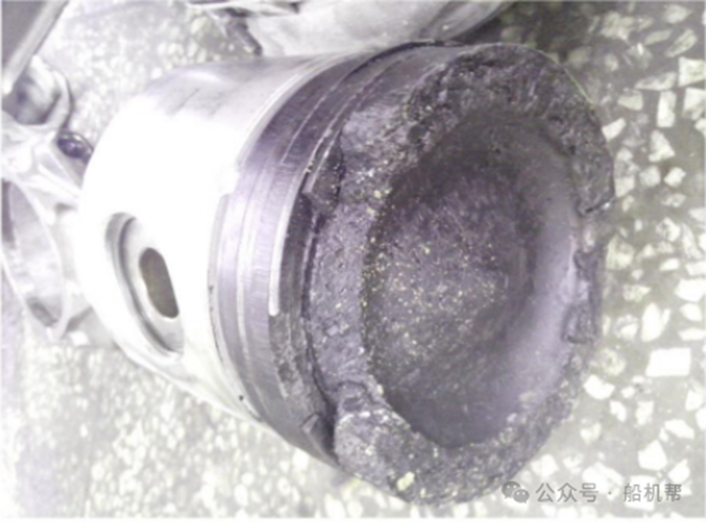
Piston corrosion is a common phenomenon in diesel engines. Corrosion typically occurs on the piston top, in the first and second piston ring grooves, and around the piston crown. It typically manifests as melt holes and perforations on the piston top surface, keyway-like notches around the crown, and honeycombs. Symptoms include increased exhaust gas flow from the engine downhole, and even oil leaking out of the breather hole.
Piston corrosion can cause abnormal diesel engine operation, directly leading to reduced cylinder pressure and power, and indirectly causing cylinder scuffing, bearing seizure, and damage to components such as the turbocharger and cylinder head.
Based on our experience repairing piston corrosion in Cummins K38 engines and incorporating relevant technical documentation, we analyze the causes of piston corrosion in Cummins K38 engines.
Piston corrosion is shown in Figure 1.
- Excessive Exhaust Backpressure
Exhaust backpressure refers to the resistance to the engine’s exhaust. The K38 engine’s exhaust pressure is less than 0.09 kPa. A clogged muffler or improper exhaust pipe modification will increase exhaust resistance, leading to excessive exhaust backpressure.
Excessive engine backpressure makes it difficult for the exhaust gas generated by the combustion of the mixture in the cylinder to be discharged. The exhaust gas is forced to flow back, trapping heat within the cylinder, causing excessively high cylinder temperatures and ultimately causing piston erosion.
- Inferior Pistons
Piercings reciprocate linearly under harsh conditions of high temperature, high pressure, high speed, and poor lubrication. Pistons come into direct contact with hot gases, reaching instantaneous temperatures exceeding 2500°C. Due to severe heat exposure and poor heat dissipation, piston temperatures are extremely high during operation, reaching 600-700°C at the top, and the temperature distribution is highly uneven.
The top of the piston is subject to significant gas pressure, particularly during the power stroke, where pressure is highest, reaching 6-9 MPa in diesel engines. This causes impacts and lateral pressure on the piston.
The piston reciprocates within the cylinder at a high speed (8-12 m/s), with this speed constantly changing. This generates significant inertial forces and places significant additional loads on the piston.
Operating under these harsh conditions, pistons can deform and wear rapidly, while also generating additional loads and thermal stresses.
If the piston is not of satisfactory quality, exhibiting defects such as pores, porosity, microcracks, and slag inclusions during casting, these defects can lead to fatigue damage under high temperature and high pressure.
The slag inclusions in the piston will first melt, causing the piston to burn and eventually lead to erosion failure.
- High levels of black smoke and severe piston carbon deposits
The formation of carbon deposits is complex and closely related to the engine structure, the type of fuel and lubricant used, and the engine’s operating conditions and operating conditions.
Insufficient oxygen supply in the combustion chamber prevents complete combustion of the fuel and lubricant that enters the combustion chamber, resulting in the production of soot and tar particles. These particles, when mixed with the lubricant, further oxidize into a thick, colloidal liquid called hydroxy acids. The hydroxy acids further oxidize into a semi-fluid, resinous colloid that adheres firmly to the components. Subsequently, under the continued high temperature, the colloid polymerizes into a more complex polymer, forming a hard, cemented carbon, which forms carbon deposits. Carbon deposits are composed of lubricating oil, hydroxy acids, asphalt, oil coke, carbon cyanide, sulfates, silicon compounds (from dust in the intake air), and trace amounts of metal shavings and their compounds.
The higher the engine temperature, the harder and denser the carbon deposits form, and the stronger their bond to the metal.
Carbon deposits in the piston ring grooves can cause the piston rings to lose their elasticity and seize, reducing their sealing performance and causing oil burning, which in turn exacerbates the formation of carbon deposits.
Carbon deposits on the intake and exhaust valves can cause the valves to close loosely. High-temperature carbon particles adhering to the valves can also cause valve and valve seat erosion, exacerbating valve leakage.
Valve leakage, in turn, allows high-temperature combustion gases to erode the valves and valve seats, further causing valve and valve seat erosion and leakage. Ultimately, this leads to reduced cylinder pressure, increased combustion smoke, and the formation of piston carbon deposits.
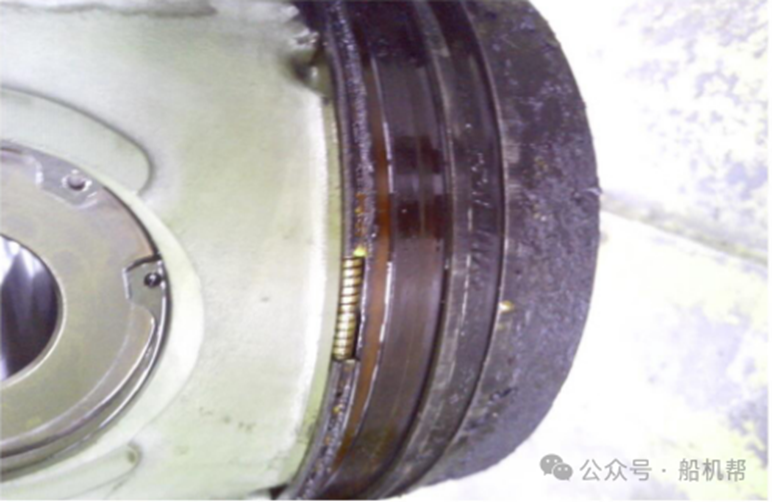
Carbon deposits on the piston weaken the heat dissipation function, increasing the temperature. When the temperature exceeds the piston’s thermal tolerance, piston erosion occurs.
Piston carbon deposits are shown in Figure 2.
The main causes of heavy black smoke and carbon deposits during engine combustion are:
- Poor valve sealing
Poorly closed intake and exhaust valves cause the high-temperature, high-pressure combustible mixture to erode the valve and valve seat working surfaces, resulting in pitting, carbon deposits, and burns. These pitting, carbon deposits, and burns further accelerate the lax closure of the intake and exhaust valves, creating a vicious cycle.
Poorly closed valves reduce cylinder pressure, resulting in poor combustion and excessive carbon deposits in the cylinder, which reduces engine power and fuel economy.
- Pump nozzle mismatch, excessive fuel injection.
The K38 engine has two models: CPL844 and CPL1628. The fuel pumps and injectors for the CPL1628 and CPL844 control numbers differ. The CPL1628 is compatible with the BA94 fuel pump and 3077760 injectors, while the CPL844 is compatible with the B844 fuel pump and 3058802 or 3076132 injectors.
The BA94 pump has a higher fuel volume than the B844 pump, and the 3058802 or 3076132 injectors have a higher fuel volume than the 3077760 injectors.
Only by correctly matching the pump and nozzle (large pump, small nozzle) can the correct injection amount be achieved. Mixing the nozzles will result in excessive fuel delivery to the final injector, causing heavy combustion smoke and damage to engine components, particularly piston erosion.
- Improper STC Valve Operation
To meet stringent emission requirements, Cummins engines have developed a new hydraulically-driven variable injection timing control system called STC (Step Timing Control).
The STC system divides engine injection timing into two parts: mechanical timing (controlled by the timing gear and camshaft), also known as “normal timing,” and mechanical-hydraulic timing (controlled by engine fuel pressure, also known as “advance injection timing”).
During starting and light-load conditions, “advance injection timing” is used, injecting fuel earlier in the compression cycle.
Under medium and heavy load conditions, “normal timing” is used, injecting fuel later in the compression cycle.
The STC valve functions as a directional control valve, with fuel pressure acting as the pilot oil pressure. The STC valve opening pressure is 27 psi, and the closing pressure is 65 psi.
If the STC valve malfunctions, engine injection timing will change, resulting in poor fuel combustion, prolonged afterburn, and the formation of carbon deposits in the cylinder. This poor piston heat dissipation can ultimately lead to piston erosion and cylinder head cracking.
- Poor Cooling Causes Overheating
The normal operating temperature of an engine is between 82 and 93°C. Insufficient coolant, oil contamination, a clogged radiator, or improper fan operation can cause excessively high cylinder temperatures.
In addition, the piston and cylinder liner primarily receive heat from the oil cooling nozzles.
If the cooling nozzles are deformed, have pinholes, or have improper injection positioning, or if the oil pressure is too low, the amount of oil injected will be reduced, directly leading to excessive piston and cylinder liner temperatures.