Since the industrialization of shipping, ships have become increasingly larger. However, with these larger ships, problems have arisen one after another. Propulsion system issues such as propeller breakage, shafting fractures, severe vibration, and main engine crankshaft fractures have caused significant economic losses and personal injuries. In-depth research has led to a new understanding of these issues. In 1894, during its first sea trials, the newly built British small destroyer HMS Courageous was found to have a main engine power of only 3,700 horsepower, 7.5% below the rated power. The speed was 24 knots, significantly below the design speed of 27 knots. For a warship, speed is a matter of life and death. How could it be so far below the design speed?
The military was dissatisfied. Repeated propeller modifications, until severe vibrations at the tail, failed to resolve the problem. On the sixth modification, engineers increased the propeller area by 45%. On another sea trial, the ship miraculously reached the planned speed of 27 knots. Why? During World War II, German submarines nearly sank all of Britain’s supply ships. Britain had no choice but to seek help from its former rival, the United States. While American-built “Liberty Ships” could be launched in an average of 42 days, a remarkably fast time, cracks and breakages in the large, tapered end of the propeller were common, with propellers even falling into the sea. Why was this so?
Since the invention of the propeller, ship propulsion systems have faced numerous challenges. While addressing these issues, humanity has also rediscovered that ship propulsion is more than just a propeller + shaft + internal combustion engine, involving numerous hair-raising engineering calculations.
A ship propulsion system, as the name suggests, is the equipment and device that propels a ship forward. But what was the earliest ship propulsion system?
Originally, ships did not have propulsion systems, even for a long time after the concept of ships emerged. Ship propulsion systems only became available after the industrialization of ships.
When ships first appeared, we couldn’t even call them ships. The earliest recorded Chinese vessel capable of carrying people on water was a boat. How did the boat come about? Ancient Chinese texts record that our ancestors “carved boats out of wood.” This meant hollowing out a thick tree in the middle so people could ride on it and float on the water. This boat was the earliest form of watercraft.
What was the propulsion system used in these earliest ships? The earliest propeller was likely the oar, a wooden plank that slid manually along the side of the boat. Later, oars, paddles, and oars were introduced. The oar, a more advanced rowing tool, was placed at the stern of a boat. It had a fulcrum fixed to the boat, with one end on board and the other in the water. The underwater section had a bow-shaped cross-section, somewhat similar to the cross-section of an airplane wing. Manually turning one end of the boat allowed for continuous operation without leaving the water, utilizing the principle of leverage for high efficiency.
During the Tang Dynasty, a man named Li Gao experimented with installing wheels on both sides of a boat, improving propulsion efficiency. From then on, boats gained another name: wheel ships. Later, with technological advancements, although the wheels were lost, ships gained a recognizable name in China: steamships.
In the 18th century, the First Industrial Revolution, which began in the West, brought steam engines to various industries. People experimented with installing steam engines on boats, connecting them to a waterwheel at the stern. Because the waterwheel was half above water and half underwater, it was also called a paddle wheel. Paddle wheels significantly improved the propulsion of ships. This marked the first time that humanity broke free from the constraints of natural forces and used the energy of chemical combustion to convert mechanical energy to propel ships.
In the first half of the 19th century, European engineers invented the propeller to propel ships. The propeller is the most dazzling and greatest invention in the history of the shipbuilding industry. It changes the direction of force transmission while significantly improving its efficiency. It can convert circular rotational torque into linear propulsion. Can anything be more amazing?
When the propeller was invented, there were no airplanes. Aircraft also operated by converting the propeller’s rotational motion into linear motion. Converting rotational motion into linear motion, and vice versa, was the purpose of the subsequent emergence of electric motors, pumps, and internal combustion engines, and it also laid the foundation for the rapid development of industry.
The combination of the propeller and the internal combustion engine, like the meeting of golden wind and jade dew, has propelled countless advancements in the maritime industry. The propeller converts the power of the internal combustion engine into… The internal combustion engine significantly increased the power available to humans, eliminating the need for natural wind or manual labor. This made possible the development of large ships, such as ships capable of carrying 24,000 containers or tankers capable of carrying 300,000 tons of oil. This significantly increased transportation capacity and trade, laying the industrial foundation for widespread division of labor and cooperation, and economic globalization.
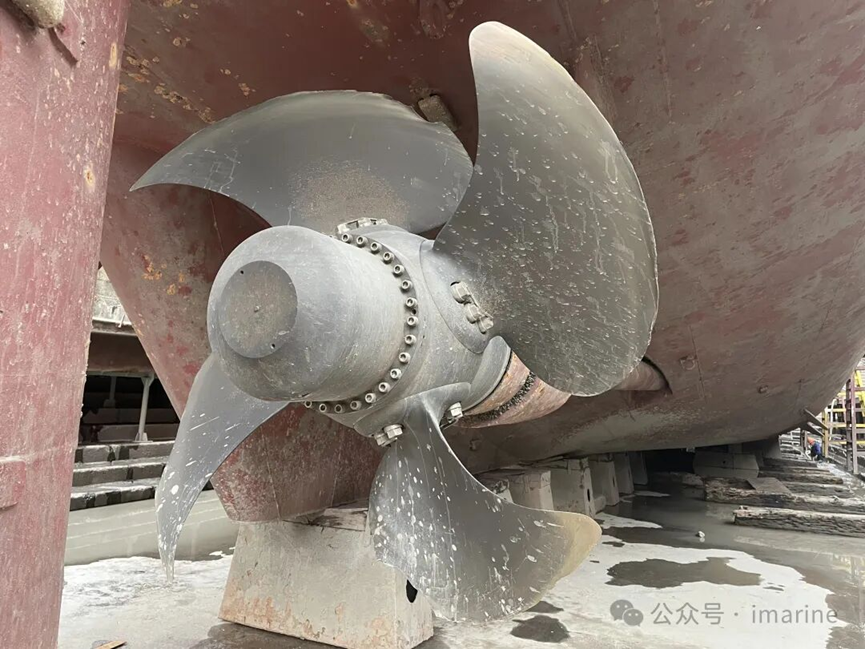
However, the large-scale development of machinery presented a series of unexpected phenomena. For example, after a period of operation, the propeller was found to have numerous holes in certain areas, and the blade tips were nearly corroded. What was the cause? In-depth research into this issue uncovered the phenomenon of cavitation and its mechanism of formation. This was also the reason why the HMS Courageous could not increase its speed, and why increasing the blade area unexpectedly solved the speed problem.
Some ships, after a period of operation, Bearings were found to be cracked, couplings were broken, and shafts were twisted into a twisted shape. The ship had to be stopped for maintenance, resulting in significant financial losses for the shipowner and a safety hazard for the crew. What was the cause? Was it due to poor shaft alignment at the shipyard, or was it due to a soft bearing base?
Speaking of shaft alignment, the British aircraft carrier HMS Queen Elizabeth experienced repeated shaft coupling fractures, and researchers suspected that improper shaft alignment was to blame. Just look at how shaft alignment, the most fundamental process in shipbuilding, could actually cause the aircraft carriers of a long-established capitalist empire to be grounded, rendering billions of dollars in warships useless.
These various safety incidents and equipment failures, all caused by the development of large-scale machinery, have garnered significant attention and research within the industry. Naval engineers have conducted extensive and in-depth study and research on the problems that arise in industrialized ships, leading to the development of two major disciplines: fluid dynamics and gyrodynamics. A thorough understanding of vibration principles helped solve the problem of “freewheel” propeller shaft fracture.
However, after resolving many issues, more problems arose. Some ships, after a period of operation, had their main engine crankshafts fractured, necessitating replacement. What caused this mechanical damage?
Other ships, after a period of operation, had their reduction gearbox teeth damaged and their elastic couplings cracked. What caused this?
Naval engineers delved deeper into the underlying causes and discovered the vibration mechanism, likely caused by torsional vibration. Therefore, today’s shipbuilding industry must address torsional, whirling, and axial vibrations from the outset when designing propulsion systems. The post-industrial shipbuilding market is no longer as simple as simply buying a diesel engine, a propeller, and adding a shaft.
In the agricultural era, people became more popular with age, as they were more youthful. A collar may represent your knowledge, and gray hair represents your experience. If others want to learn some livelihood skills, they should respect the elderly. In the industrial age, knowledge is constantly updated, and veterans often encounter new problems. This requires new talent with advanced research capabilities, and a person may need to continuously learn throughout their lives. For example, in recent years, the shipbuilding industry has encountered new problems that even veterans find difficult to understand:
For environmental protection, some ships use stainless steel shafts. However, during dry dock inspections, several corrosion pits were discovered on the shafts. If the pits continue to expand, the shafting may break, putting the ship in great danger. What causes this?
With the advancement of science and technology, the electrification of ships is becoming a growing trend. The advent of electric propulsion, in particular, has revolutionized ship propulsion methods. However, this has also brought new problems and phenomena. For example, pitting on shaft bearings caused by burns can affect the bearing’s function and the shaft’s stability. The system transmits force. In severe cases, bearings can be extensively damaged, necessitating ship replacement.
Sometimes, ship electronics burn out, and sometimes, inexplicable malfunctions occur. For example, a ship may function normally during normal docking and undocking operations. However, while stationary at the dock and testing the lateral thrusters, it is discovered that the power transformers for other equipment have burned out. Why?
Sometimes, when using a shaft generator, other electronic equipment fails to function. Simply shutting down the shaft generator restores the electronics to normal operation. Sometimes, simply adding a transformer solves the problem. What is the problem?
The aforementioned phenomena all fall within the scope of ship propulsion system research, a systems engineering project requiring comprehensive and integrated research. In the early stages of design, the various components are generally mature and present no issues. Gearboxes, motors, diesel engines, propellers, inverters, and so on are all mature products, and there is a high probability that these components will not fail. There won’t be any problems. However, if they’re put together, problems may arise. For example, an 8-cylinder diesel engine driving a 4-bladed propeller may cause vibration issues.
Thus, ship propulsion system research is a comprehensive research topic. Putting these systems together is like a traditional Chinese medicine practitioner taking a patient’s pulse, observing, smelling, asking, and palpating, and then treating them comprehensively. Specialized research, on the other hand, is like Western medicine, treating the symptoms. The gearbox, the diesel engine, the inverter, and the motor are all fine, but when put together, problems may arise.
The most challenging part of shipbuilding is the propulsion system. An outsider might say, “What’s the big deal? It’s just a propeller shaft and a diesel engine!” Yes, that’s right. If there are no problems, they’re easy to fix. But if there are problems, it’s like the British Empire’s aircraft carriers, causing your ship to malfunction every other day.
Thus, the most important and complex ship equipment is the propulsion system, and the most challenging part is for those who research ship propulsion systems.